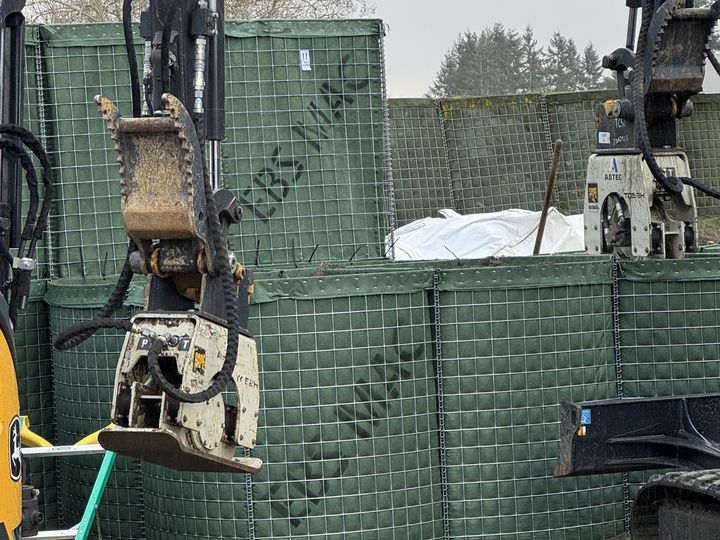

OTJIKOTO GOLD MINE
Challenge
Otjikoto Mine, located in north-central Namibia, is operated as a large-scale open-pit gold mine. The pit comprises benches excavated in heterogeneous metamorphic and intrusive rock formations subject to progressive weathering, joint dilation and localised surficial instability. Routine geotechnical monitoring recorded increasing rates of shallow sloughing and raveling along highwall faces, driven primarily by surface erosion, stress-relief fracturing and the presence of unfavourable discontinuity orientations.
A section of the eastern highwall exhibited accelerated degradation following a seasonal rainfall period, prompting concern regarding safety, ore access continuity, and compliance with mine geotechnical TARP (Trigger Action Response Plans). The mine required an immediate, engineered containment solution that could stabilise loose blocks, prevent further raveling, and ensure safe working conditions on active production benches.
Geotechnical inspections identified:
Surface erosion and ravelling along a 35–45 m high exposure with a bench width insufficient for mechanical scaling.
Rock mass characterised by blocky, jointed units, with persistent discontinuities day-lighting onto the slope face, increasing the likelihood of wedge- and planar-type failures.
Progressive deterioration following rainfall infiltration, driving reduction in cohesion and increased detachment of surficial material.
Hazard to personnel and equipment operating on lower benches, with recorded rockfall events (50–150 mm fragments) posing an operational risk.
Urgent requirement due to production sequencing—delays would impact gold output and mine planning targets.
The mine needed a rapidly deployable, robust, and low-maintenance protection system capable of containing ongoing raveling without requiring heavy bench re-profiling or extended access delays.
Solution
Maccaferri proposed a Simple Drapery Rockfall Protection System, selected for its ability to:
Conform to irregular rock faces with minimal preparation.
Provide continuous containment of loose blocks and debris.
Require limited anchoring, enabling rapid installation in access-constrained benches.
Offer long-term resistance to UV, abrasion, and corrosion under harsh Namibian climatic conditions.
Solution Components
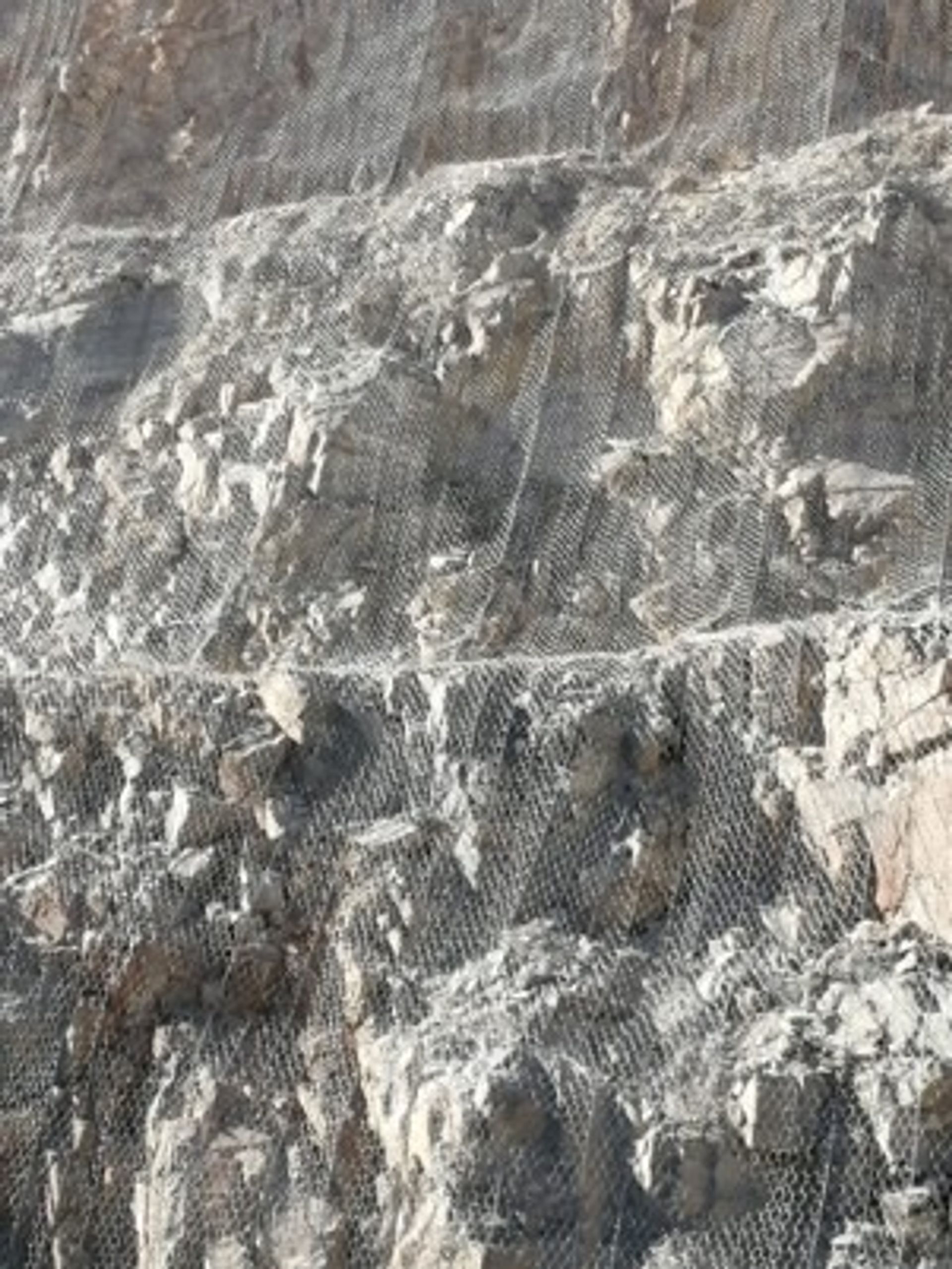
High-tensile Galfan® coated double-twisted steel wire mesh (2.7 mm) with steel rope cables:
Provides flexibility to drape over the rock mass.
Ensures high tensile strength and uniform load distribution.
Perimeter and crest anchorage system:
20–25 mm fully-grouted rock bolts (L = 2.5–3.0 m), spaced at 2.5 m c/c.
Steel cable (Ø 12 mm) used as a crest support rope, anchored to distribute vertical loads.
Foot-of-slope toe management:
Mesh directed into a toe trench or ballasted using steel bars to ensure proper load transfer.
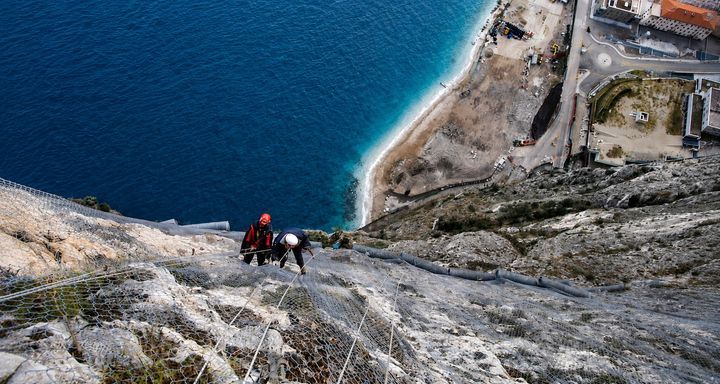
Drapery systems act passively, allowing detached blocks to travel down the mesh while controlling their trajectory. A prestressed crest cable anchors the mesh and carries vertical loading. Secondary anchors distribute loads across panels. Toe control prevents uncontained ejection of material onto working benches.
Our products for
this Success Story
Get in touch with us
[contactForm_txtSuccessSubmit]